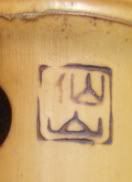
Tsurugi Kyomudo, master shakuhachi maker
I've been involved in a very general way with shakuhachi making for some time now. I came into it innocently enough. Just being around my teacher(Tsurugi Kodo) and his father(Tsurugi Kyomudo), who has been a master shakuhachi maker for well over 50 years, was sufficient to prick my curiosity on the matter. A few well placed questions caused later and I was thinking of trying to make an instrument myself.
The physical calculations and work went by rather smoothly. I had some training in the art of crafting Noh masks before I tried to make a shakuhachi, so the idea of tedious work was no stranger to me.
It often surprised me prior to having made my first shakuhachi, how much time was involved in its immergence into a playable instrument. It seemed like such a simple construction: a tube, some holes and a blowing edge. I soon learned that there was so much more.
After the initial process of removing the oils and resins by heating, and the initial exposure to sunlight to change the surface colour (about two weeks), the bamboo has to go through a period of curing in relative darkness and controlled humidity. Generally, between one and three years is good for that. Thereafter, the bamboo might need to be straightened in a jig.

As a rule of thumb, a curve on the front side of the instrument upward from the bell is good, but a curve in any other direction is not good. It actually doesn't affect the sound, but it is an aesthetic consideration. After bending, the physical act of measuring and cutting to length, removing internal node membranes, opening up the bore in the root end, cutting the angle of the blowing edge and inserting the blowing edge inlay and drilling holes happens. If the flute is to be made as a
jinashi shakuhachi (no
ji paste applied to the bore for tuning purposes) then the maker will remove small amounts of bore wall material in specific places in order to improve tone and volume. If the instrument is to become a
jiari (
ji paste is applied for tuning, sound colour and volume) then a mixture of
tonoko (crushed rock powder) and urushi (Japanese lacquer) is applied to the bore walls then removed incrementally by sanding until the desired sound is achieved. This step can take a great deal of time that often comes with frustration. To say the least, it's often a question of hit-and-miss at this stage until you've aquired years of experience under your belt.
As it is, I prefer to make jinashi flutes for now.