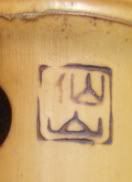
Within the world of the shakuhachi maker, a particular means of identification has been in use at least since the 8th century. It comes by way of a stamp made from stone, bone, wood or metal that carries the maker's symbol, usually made from one or more Chinese characters(kanji) significant to the maker and is commonly known as 'hanko'.
This method of identification was formally introduced to Japan in 701 from China, and has been used in a general sense as a signature to bind any and every legal contract in Japan. "Jitsuin," or "true seals" are registered with the local authorities and used on important legal documents. Japanese also carry personal hanko for everyday use.
The shakuhachi maker's hanko has evolved from a simple carving in the body of the instrument to a much more elaborate inscription typically burned into the skin of the instrument from a metal stamp. Though these are intended to be the mark of the maker, they aren't legally controlled or registered, thus leading to a great deal of ambiguity when attempting to discover the identity of some long-dead, and possibly forgotten maker.
I've recently become interested in these marks as a result of collecting many older intruments. My often frustrated inquiry into the identity of a maker has lead me to begin to compile as many photos of hanko as I can and to soon post them on the internet with whatever information that I can find. I hope to publish this photo database in English soon as a service to others who would like to know more about their particular instrument.

