Friday, December 19, 2008

Isolation and Change


The realities of shakuhachi practice in Japan are such that cells or pockets of players have developed as a means of self-identification/justification and/or a way of continuing the peculiarities of a teacher.
The reasons that these cells (ryuha) have developed are many, but probably were inspired by the relative imobility of Japanese in history. Being an agrarian society by-in-large promotes stationary life. Crops need tending to, animals need care, land needs maintaining. The concept of distant travel was relegated to those with the luxury of time, which often equated to disposable money. Domestic travel with shakuhachi in hand was, for many years, was the mainstay of wandering itinerate monks known as Komuso or Monks of Emptiness. Theirs was not a teaching excersise, but rather a response to the call of the universe and a means of setting themselves in it. It wasn't until the post-WWII era that Japanese in general started to search out new things with their newly found disposable wealth. Along with this travel came the spread of many things Japanese to the outside world; including the shakuhachi. Naturally, any player who ventured outside of Japan would take their particular learned mothod with them and expose any who would listen. What was heard became the represented norm to outsiders. The concept of 'shakuhachi' became one thing. With that, and the realization to those new listener/learners came the idea that isolated schools of thought were not a necessity and could/should be grasped equally. Interestingly enough, to many, the original sounds of the Monks of Emptiness resonated and that is where their real learning began. The evolution then went from isolated pockets to more isolated pockets but in a culturally different setting. All of this changed with the advent of the internet. Now learners can not only purchase high quality instruments, but get online lessons from not just one teacher, but many. One wonders what the outcome of this will be. Will we see the isolationism of the past fade? Will we see the defining lines of the ryuha dissapear? The future is indeed interesting.

Friday, December 12, 2008

The Path of the Maker

Tsurugi Kyomudo, master shakuhachi maker
I've been involved in a very general way with shakuhachi making for some time now. I came into it innocently enough. Just being around my teacher(Tsurugi Kodo) and his father(Tsurugi Kyomudo), who has been a master shakuhachi maker for well over 50 years, was sufficient to prick my curiosity on the matter. A few well placed questions caused later and I was thinking of trying to make an instrument myself.
The physical calculations and work went by rather smoothly. I had some training in the art of crafting Noh masks before I tried to make a shakuhachi, so the idea of tedious work was no stranger to me.
It often surprised me prior to having made my first shakuhachi, how much time was involved in its immergence into a playable instrument. It seemed like such a simple construction: a tube, some holes and a blowing edge. I soon learned that there was so much more.
After the initial process of removing the oils and resins by heating, and the initial exposure to sunlight to change the surface colour (about two weeks), the bamboo has to go through a period of curing in relative darkness and controlled humidity. Generally, between one and three years is good for that. Thereafter, the bamboo might need to be straightened in a jig. As a rule of thumb, a curve on the front side of the instrument upward from the bell is good, but a curve in any other direction is not good. It actually doesn't affect the sound, but it is an aesthetic consideration. After bending, the physical act of measuring and cutting to length, removing internal node membranes, opening up the bore in the root end, cutting the angle of the blowing edge and inserting the blowing edge inlay and drilling holes happens. If the flute is to be made as a jinashi shakuhachi (no ji paste applied to the bore for tuning purposes) then the maker will remove small amounts of bore wall material in specific places in order to improve tone and volume. If the instrument is to become a jiari (ji paste is applied for tuning, sound colour and volume) then a mixture of tonoko (crushed rock powder) and urushi (Japanese lacquer) is applied to the bore walls then removed incrementally by sanding until the desired sound is achieved. This step can take a great deal of time that often comes with frustration. To say the least, it's often a question of hit-and-miss at this stage until you've aquired years of experience under your belt.
As it is, I prefer to make jinashi flutes for now.

Friday, December 5, 2008

Hanko


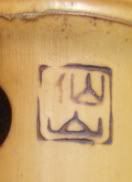
Within the world of the shakuhachi maker, a particular means of identification has been in use at least since the 8th century. It comes by way of a stamp made from stone, bone, wood or metal that carries the maker's symbol, usually made from one or more Chinese characters(kanji) significant to the maker and is commonly known as 'hanko'.

This method of identification was formally introduced to Japan in 701 from China, and has been used in a general sense as a signature to bind any and every legal contract in Japan. "Jitsuin," or "true seals" are registered with the local authorities and used on important legal documents. Japanese also carry personal hanko for everyday use.

The shakuhachi maker's hanko has evolved from a simple carving in the body of the instrument to a much more elaborate inscription typically burned into the skin of the instrument from a metal stamp. Though these are intended to be the mark of the maker, they aren't legally controlled or registered, thus leading to a great deal of ambiguity when attempting to discover the identity of some long-dead, and possibly forgotten maker.

I've recently become interested in these marks as a result of collecting many older intruments. My often frustrated inquiry into the identity of a maker has lead me to begin to compile as many photos of hanko as I can and to soon post them on the internet with whatever information that I can find. I hope to publish this photo database in English soon as a service to others who would like to know more about their particular instrument.