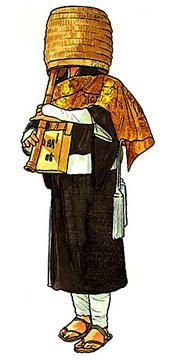
I've been involved in searching madake bamboo groves in central Kyushu, Japan for suitable bamboo to make shakuhachi for the past 22 years. My interest began when my teacher, Tsurugi Kodo, asked me to join he and his father (master maker Tsurugi Kyomudo) in the bamboo hunt. The more hands, the easier the task was. I came to enjoy the atmosphere offered in the quiet of a large bamboo grove. Typically every year we harvest about 40 or 50 culms (pieces of bamboo including the root) for making shakuhachi. It's hard work, but very enjoyable. In recent times, my teacher Tsurugi Kodo and I have been hosting an international group headed by shakuhachi maker/teacher Alcvin Ramos from Vancouver, Canada.. We take the tour members through the process of choosing a suitable piece of bamboo according to their needs, and doing initial preparation like aburanuki which is a process of removing the oils and resins from the bamboo and begins the long curing process. We are very pleased to share our time and knowledge with those who seek it out. In this way we are perpetuating this ancient craft
 Alcvin Ramos from Bamboo-In, Canada


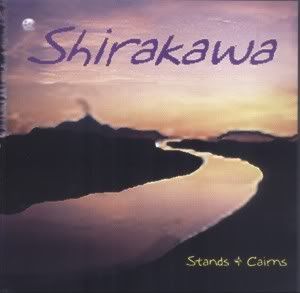 My interest in learning shakuhachi wasn't just to assimilate the tradition, but to use it toward my own interests. I've always been interested and involved in performance and the addition of the shakuhachi to this part of my life was no different. In 1996, I released my first commercial CD recording on my private label Healing Fugu Records with my then bandmates Darby Stands, Kyousuke Yamaoka, Sho Tajiri and Keisuke Hirayama together known as Stands & Cairns. This was a completely original effort that included 9 instrumental pieces that blended western folk/rock aesthetic with what I gleened from my 10 years of shakuhachi study at the time. In retrospect, I think it was a good effort and one that people still comment about favourably. What do you think? You can check it out here.